Higher Education System
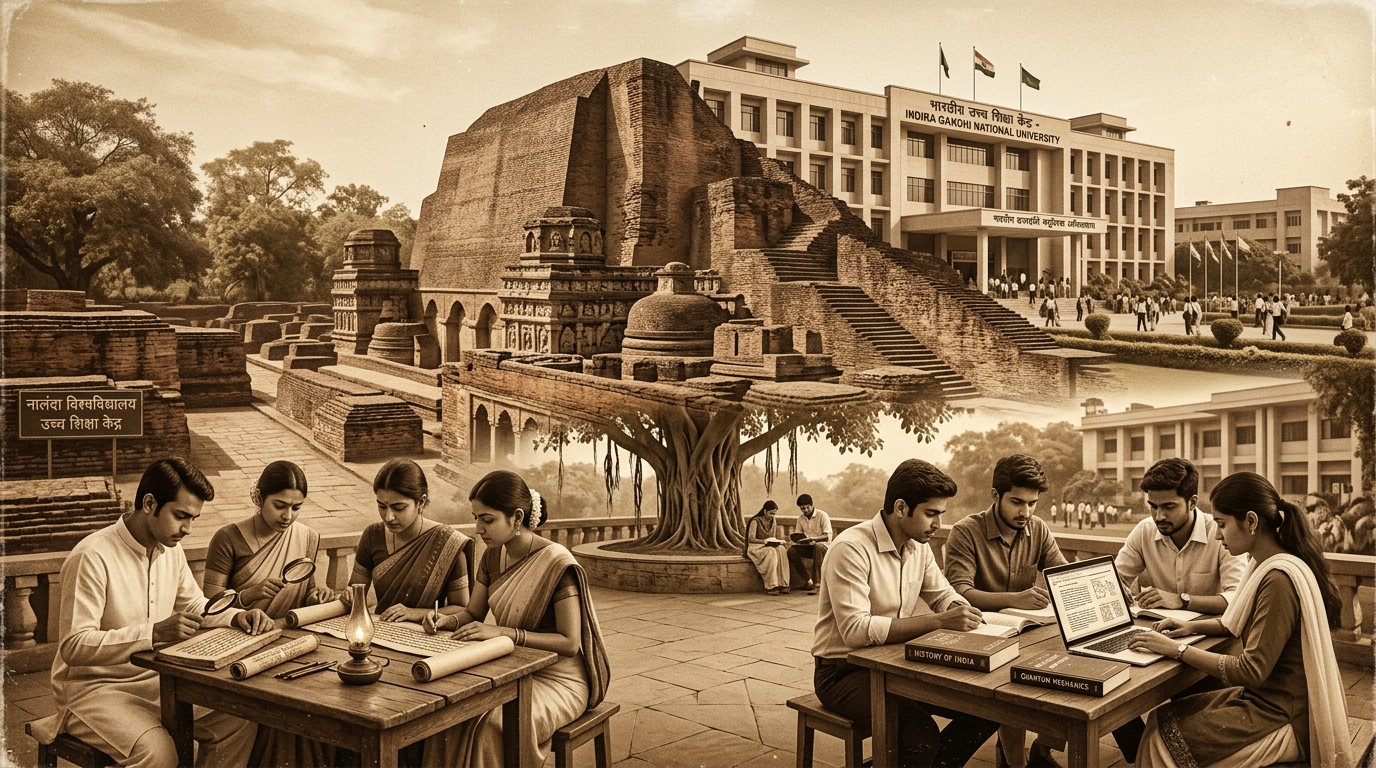
India possesses one of the oldest and most extensive higher education systems in the world. To master this unit for the UGC NET examination, candidates must bridge the ancient past—the sprawling monastic campuses of Nalanda and Takshashila—with the complex, modern regulatory frameworks established post-independence.
This final chapter serves as both a historical narrative and an administrative manual. You will trace the evolution of educational commissions (from Radhakrishnan to the NEP 2020) and memorize the critical functions of apex bodies like the University Grants Commission (UGC) and the All India Council for Technical Education (AICTE).
Chapter Outline
-
10.1 Institutions in Ancient India
The Vedic and Buddhist systems of education. Deep dives into Takshashila, Nalanda, Vikramshila, and Valabhi.
-
10.2 Post-Independence Evolution
The chronological evolution of higher learning: Radhakrishnan Commission, Kothari Commission, and the National Education Policies (1968, 1986, 2020).
-
10.3 Learning Programmes in India
Understanding the differences between Oriental, Conventional, Non-conventional (Distance learning), and Skill-Based/Technical education.
-
10.4 Value & Environmental Education
The philosophical shift towards integrating constitutional values, ethics, and sustainability into the modern university curriculum.
-
10.5 Governance, and Administration
The architecture of the system: Central vs. State vs. Deemed Universities, and the regulatory roles of the UGC, AICTE, and NAAC.